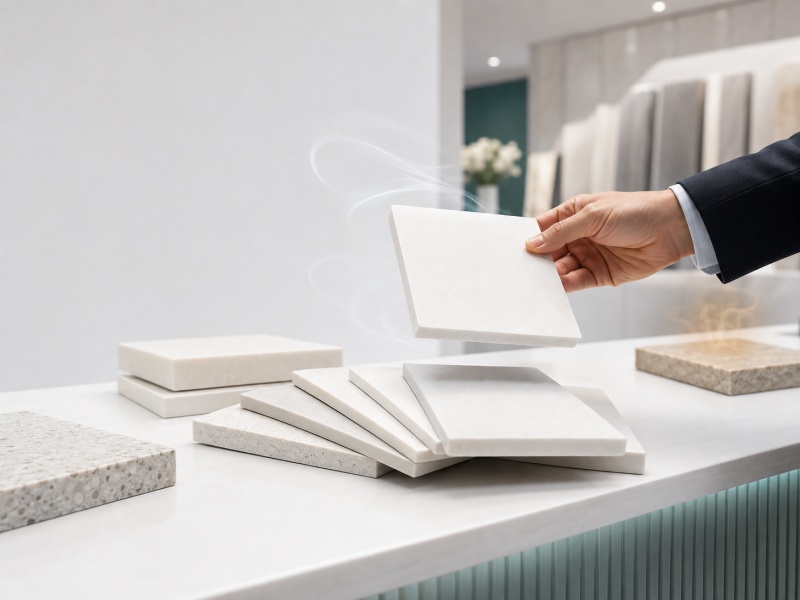
At the Canton Fair, a visitor picked up one of our solid surface samples, smelled it and asked a surprisingly important question:
“Why does your sample have almost no noticeable odor, while the solid surface I currently purchase smells much stronger?”
Other industry professionals have raised a similar concern. Some even mentioned a particular low-priced product on the market that was known for an unusually strong and unpleasant smell.
This raises a question that matters to distributors, fabricators, designers and project buyers alike: Where does the smell of solid surface come from—and can an unusually strong odor indicate a problem with the material or manufacturing process?
The short answer is that properly cured pure acrylic solid surface should normally have only a faint odor at room temperature. A strong or persistent smell is not, by itself, proof that a product is unsafe or substandard, but it is a legitimate warning sign that deserves closer investigation.
Pure Acrylic Solid Surface Is Not Simply “Smelly Acrylic Resin”
Pure acrylic solid surface is generally made from an acrylic resin matrix—primarily polymethyl methacrylate, or PMMA—combined with alumina trihydrate (ATH), pigments and a small amount of curing and processing additives.
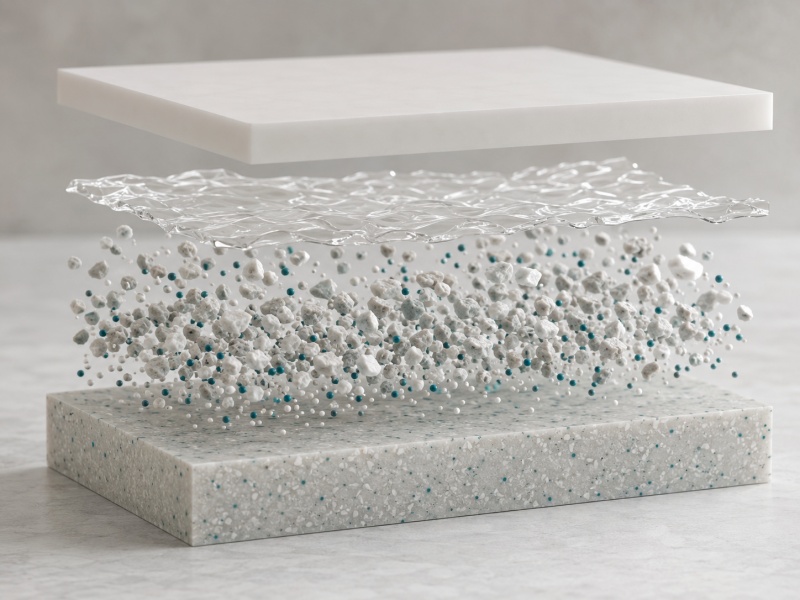
Once methyl methacrylate (MMA) has been properly polymerized into PMMA, the resulting high-molecular-weight polymer has very low volatility at room temperature. In other words, fully cured PMMA itself does not readily evaporate into the air.
The faint “acrylic” smell sometimes noticed in a new sheet normally comes from very small amounts of low-molecular-weight substances, such as:
- Residual MMA monomer that has not fully reacted;
- Other methacrylate monomers or crosslinking agents;
- Trace decomposition products from initiators and curing agents;
- Minor volatile components in pigments, dispersants or processing additives;
- Volatiles temporarily trapped by protective film and packaging.
MMA has a distinctive fruity, sharp and slightly irritating odor, and the human nose can detect it at a very low concentration. This means that a detectable smell does not automatically indicate a high exposure level. However, when the odor is unusually strong, persistent or irritating, the concentration or composition of the volatile substances may be different from that of a well-made sheet.
Why Can Some Solid Surface Products Smell Unusually Strong?
Several factors may be responsible. In lower-cost production, more than one can occur at the same time.
1. Excessive Residual MMA Caused by Incomplete Polymerization
This is one of the most likely causes of a strong acrylic odor.
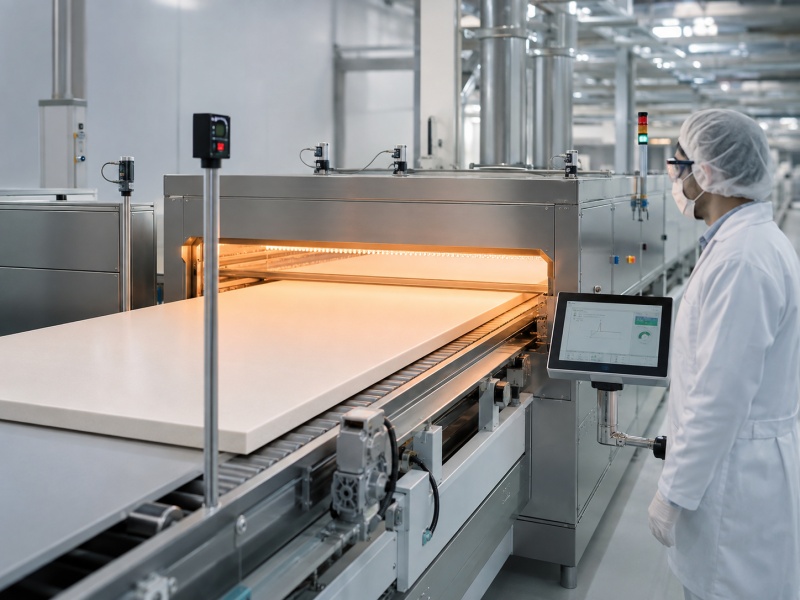
During production, MMA must be converted into PMMA through a carefully controlled polymerization and curing process. If the initiator dosage, mixing, curing temperature or curing time is not properly controlled, too much unreacted MMA may remain inside the sheet.
Possible causes include:
- Insufficient or deteriorated initiator;
- An incorrect initiator-to-accelerator ratio;
- Poor dispersion or uneven mixing;
- A curing temperature that is too low or unstable;
- A shortened curing or post-curing cycle;
- Premature demolding, stacking or packing;
- Local temperature differences across the sheet.
The trapped monomer then diffuses gradually from the material. A sheet with this problem may smell much stronger when its protective film is removed, when a fresh edge is cut or when the material is warmed during fabrication.
Shortening the curing cycle can increase output and reduce energy cost, but it may also leave more residual monomer in the finished product. This is one example of how an apparently small manufacturing shortcut can affect the buyer’s experience later.
2. Lower-Purity or Poorly Controlled Recycled Raw Materials
Recycled acrylic feedstock can be used responsibly when it is properly purified and controlled. The issue is not the word “recycled” itself; the issue is inconsistent purity and inadequate process control.
Poorly refined recycled MMA or mixed acrylic waste may introduce methacrylic acid, oligomers, oxidation products, aldehydes, ketones or traces of other polymers. These substances can create an odor that is more sour, burnt, solvent-like or unpleasant than the typical faint smell of MMA.
Lower-cost raw material may therefore save money at the purchasing stage while increasing odor variation, color instability or batch-to-batch inconsistency.
3. Substitution with Polyester or a Mixed Resin System
Not every product sold under a broad “acrylic solid surface” description is necessarily a pure acrylic material.
Modified solid surface may contain unsaturated polyester resin, often used with styrene. Styrene has a strong, sweet and heavy solvent-like odor commonly associated with fiberglass or polyester products. If a sheet has a persistent smell that differs noticeably from the light, sharp odor of MMA, the resin system itself should be verified.
Polyester-based and modified materials have legitimate applications and price positions when they are accurately identified. The concern arises when a lower-cost resin system is presented as equivalent to pure acrylic solid surface without clear disclosure.
4. Low-Grade or Excessive Additives
Solid surface formulations may contain initiators, accelerators, crosslinkers, dispersants, release agents, pigments and other processing aids. Their quality and dosage matter.
Excess aromatic amine accelerator, unsuitable pigment paste, low-grade release agent or contaminated decorative particles can introduce amine-like, chemical, oily or solvent-like odors. Although these ingredients represent only a small percentage of the formulation, some have very low odor thresholds and can strongly influence how the finished sheet smells.
ATH filler itself is normally not the primary odor source. However, its moisture level, surface treatment, purity and storage condition can indirectly affect polymerization, additive demand and the retention of volatile substances.
Does a Lower Price Always Mean Stronger Odor?
No. Price alone cannot determine material quality, and odor alone cannot provide a complete chemical or safety assessment.
Nevertheless, an exceptionally low price must come from somewhere. Cost may be reduced through efficient automation, scale and supply-chain management—but it may also be reduced by:
- Substituting a less expensive resin system;
- Using inconsistent or insufficiently purified feedstock;
- Choosing lower-grade pigments and processing aids;
- Shortening curing and post-curing time;
- Reducing ventilation, conditioning or quality-control steps;
- Packing sheets before residual volatiles have adequately dissipated.
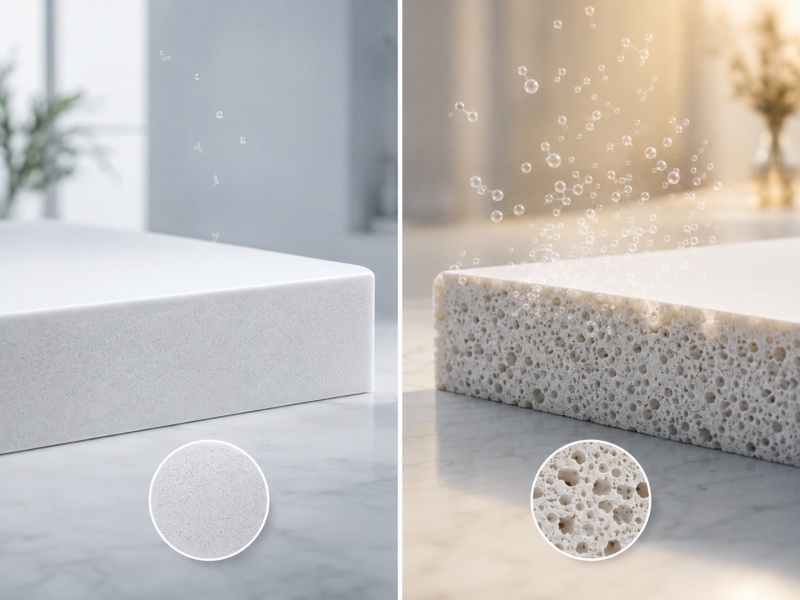
When an unusually low price appears together with a strong and persistent odor, inconsistent color, low hardness or unstable fabrication performance, buyers should not dismiss these signals. The initial sheet price is only one part of the total cost. Complaints, fabrication losses, project rejection and damage to a distributor’s reputation can cost much more.
Why Gelo Solid Surface Has a Low and Consistent Odor
At Gelo, we believe that low odor should be the natural result of disciplined material selection and manufacturing control—not a fragrance used to cover a formulation problem.
Our focus is on the fundamentals: a genuine acrylic resin system, controlled raw materials, accurate formulation, thorough mixing, stable polymerization, sufficient curing and consistent batch inspection. These factors help minimize residual volatile substances while supporting the mechanical, aesthetic and fabrication performance expected from quality solid surface.
The sample noticed by our Canton Fair visitor was not made “odorless” for the exhibition. Its low odor reflected the material and process behind it.
For buyers, the lesson is simple: **do not evaluate solid surface by price alone.** Ask what resin is being used, how the sheet is cured, what quality controls are in place and whether the supplier can support its claims with testing. A surface that looks similar in a small sample may perform—and smell—very differently once it is fabricated, installed and used indoors.
Choosing a dependable solid surface is not merely purchasing a sheet. It is protecting the quality of the finished project, the experience of the end user and the reputation of your business.


 English
 Français
 Русский
 Español
 Português
 عربي
عربي