Compare solid surface and quartz for commercial countertops. See differences in durability, seams, hygiene, repair, design flexibility, maintenance, and cost.
Solid Surface vs. Quartz at a Glance
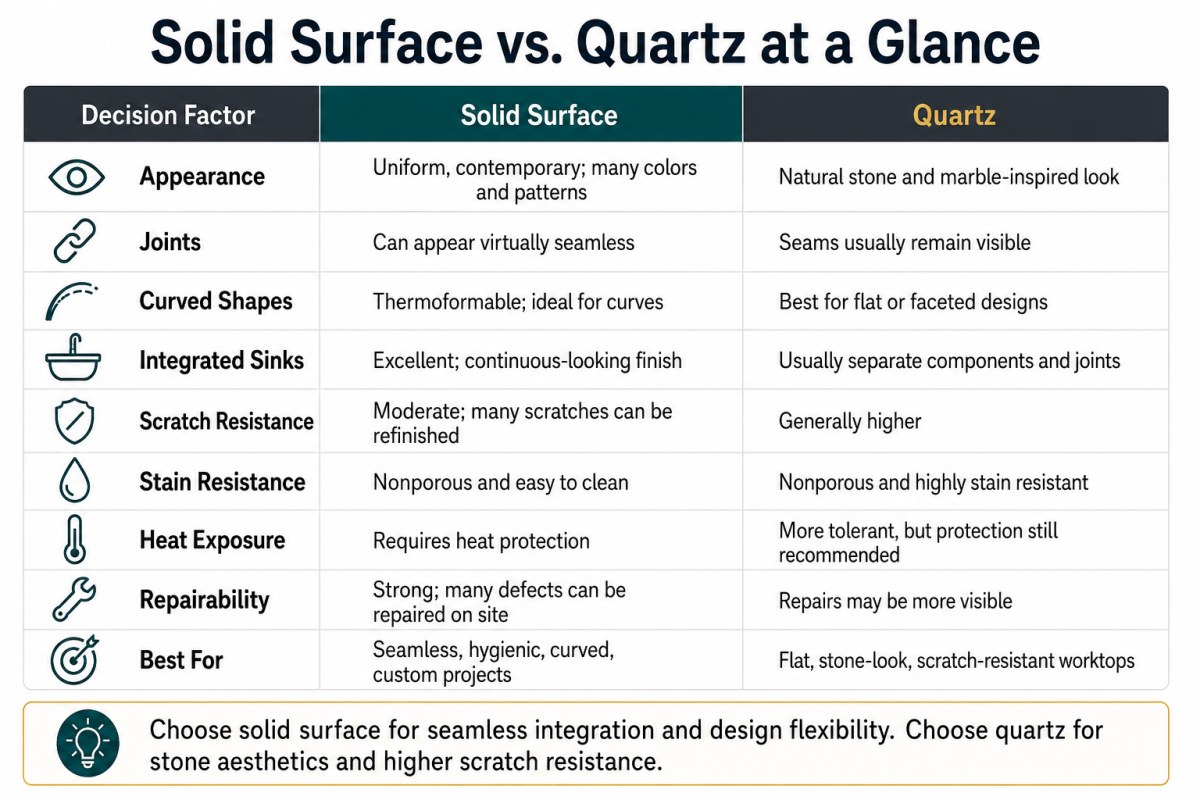
Specify solid surface when the project is driven by shape, seamless integration, hygiene, or future repair. Specify quartz when the project is driven by stone aesthetics and resistance to everyday scratching on predominantly flat surfaces.
What Is Solid Surface?
Solid surface is a homogeneous, nonporous surfacing material made with mineral filler, resin, and pigments. Acrylic solid surface sheets can be cut, routed, bonded, sanded, and—in suitable colors and formulations—thermoformed into curved shapes.
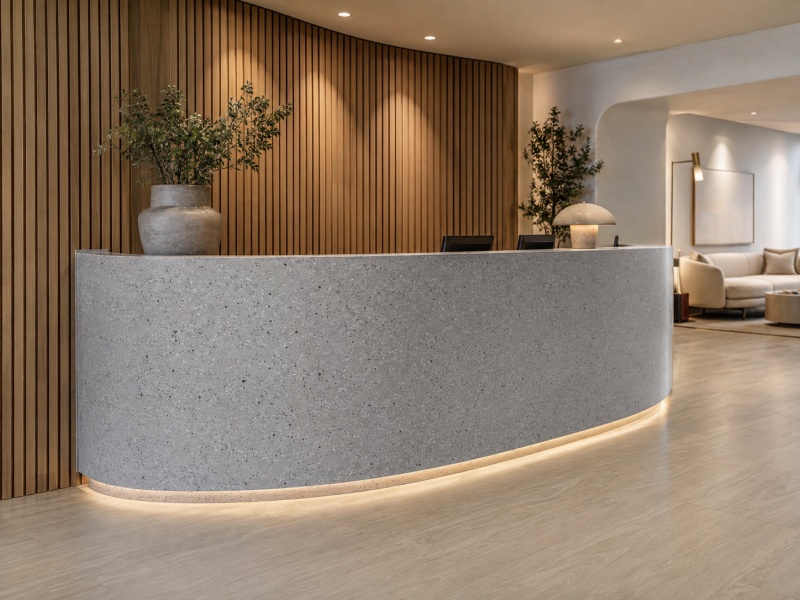
Because the material is consistent through its thickness, many surface scratches and signs of wear can be removed by refinishing. Compatible sheet joints can also be bonded and sanded to create a continuous-looking installation. These characteristics make solid surface particularly useful where a commercial interior needs integrated sinks, coved backsplashes, long counters, curved reception desks, or repeated modular elements.
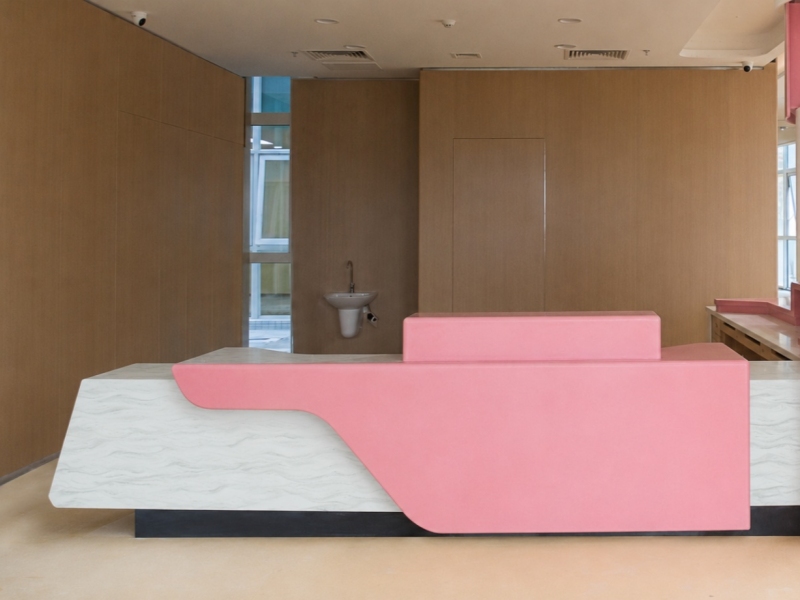
Common commercial applications include:
- Hospital and clinic countertops
- Laboratory and dental work surfaces
- Hotel bathroom vanities
- Restaurant service counters
- Retail display fixtures
- Office reception desks
- Airport and public-space furniture
- School and university washrooms
- Wall cladding and decorative features
What Is Quartz?
Quartz surfacing—often called engineered quartz—is a manufactured slab material made from mineral-based particles combined with resin, pigments, and other ingredients. Exact compositions vary across brands and current product technologies.
Quartz is valued for its hard surface, strong scratch and stain resistance, and convincing stone-inspired patterns. It is typically fabricated with equipment and techniques used for engineered stone. Quartz works particularly well for straight or angular countertops where a natural stone appearance is more important than invisible joints or complex three-dimensional forming.
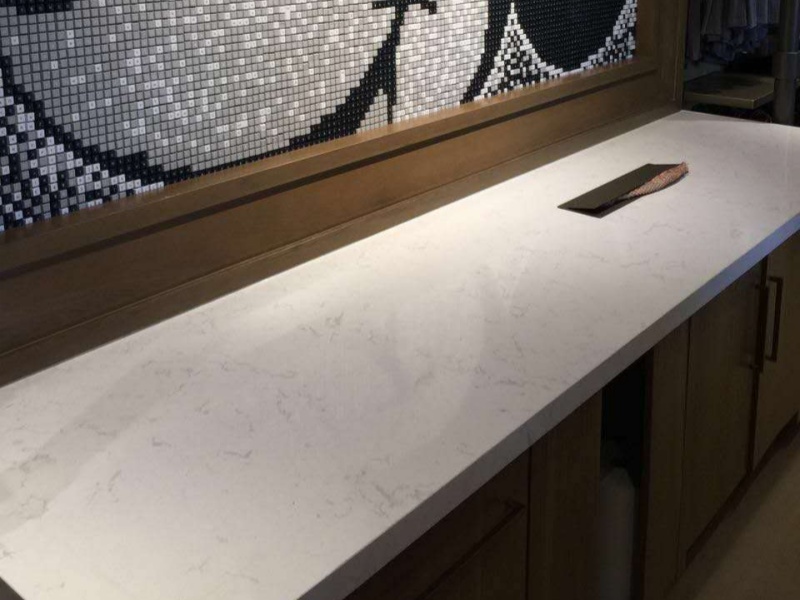
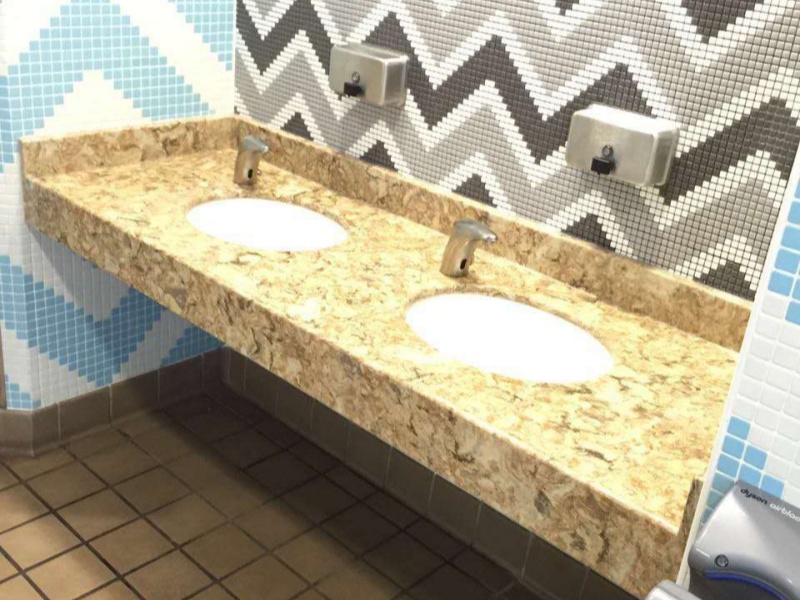
Common commercial applications include:
- Hotel vanity tops
- Apartment and hospitality kitchens
- Bar and restaurant counters
- Office pantry countertops
- Retail transaction counters
- Flat worktops in low-to-medium impact environments
1. Durability in High-Traffic Commercial Spaces
Both materials can perform well in commercial interiors, but they respond differently to damage.
Quartz generally offers better resistance to everyday scratching. This can be valuable on counters where keys, trays, equipment, or abrasive objects frequently move across the surface. However, an impact that chips an edge or damages a quartz seam may be difficult to disguise completely.
Solid surface scratches more readily, especially in dark colors or high-gloss finishes. Its advantage is renewability: many superficial scratches, scuffs, and localized marks can be sanded and refinished. If a section is seriously damaged, a trained fabricator may be able to cut out and replace the affected area.
For commercial owners, the question is therefore not simply, “Which material is harder?” A better question is, “What kind of damage is likely, and how easily can the installed surface be restored?”
Choose quartz when:resistance to routine abrasion is the main concern.
Choose solid surface when:repairability and extending the useful appearance of the installation are more important.
2. Seams, Hygiene, and Cleaning
Both solid surface and quartz are nonporous when correctly manufactured and installed, so neither normally requires periodic sealing. Both can support straightforward cleaning protocols, subject to the cleaning and chemical-resistance guidance of the selected manufacturer.
Solid surface has an important design advantage: compatible sheets can be joined with color-matched adhesive and finished so the joints are inconspicuous. Sinks and coved backsplashes can also be integrated, reducing exposed rims, grout lines, and dirt-catching transitions.
Quartz seams are normally visible, even when the color is carefully matched. Undermount sinks also create a material transition at the bowl edge. These details are acceptable in many hospitality and office settings, but they may be less desirable where continuous detailing and simplified cleaning are priorities.
This is why solid surface is frequently considered for healthcare, dental, laboratory, food-service, and public washroom projects. The final suitability of any material must still be confirmed against local regulations, required certifications, cleaning chemicals, and the manufacturer’s technical documents.
3. Design Flexibility and Custom Fabrication
Solid surface is the clear winner when a project includes curved or sculptural forms.
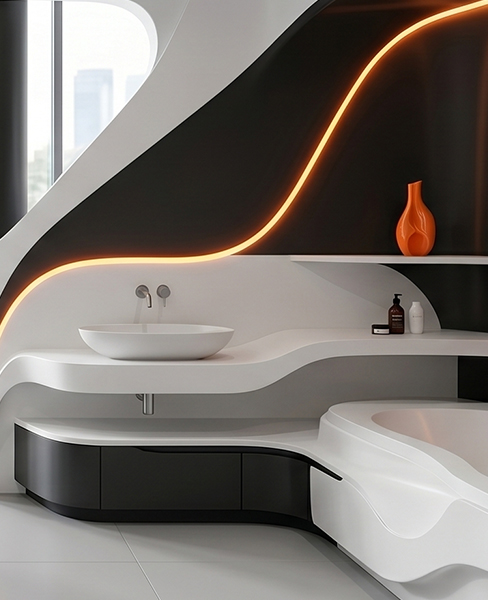
Depending on the product, color, thickness, tooling, and forming conditions, acrylic solid surface can be heated and shaped over molds. Fabricators can create curved reception counters, rounded end panels, integrated washbasins, flowing retail displays, and illuminated translucent features. Sheets can also be machined with common woodworking-style fabrication equipment.
Quartz is highly effective for flat slabs and crisp geometric layouts, but it is not normally thermoformed. Curved quartz designs typically require segmented pieces, specialist cutting, and more visible joints. This can increase fabrication complexity and restrict the designer’s freedom.
For straight worktops and stone-inspired visuals:quartz has an advantage.
For seamless curves, integrated components, and custom shapes:solid surface has an advantage.
4. Heat, Stains, and Chemical Exposure
Commercial material specifications should never rely on the general label “heat resistant.” The expected temperature, exposure time, appliance arrangement, cutout design, support, and thermal expansion details all matter.
Solid surface can be damaged by direct contact with very hot cookware or poorly insulated heat-producing equipment. Quartz is often more resistant to brief contact with moderate heat, but resin-containing quartz surfaces can also be affected by high temperatures or thermal shock. Manufacturers of both material categories commonly recommend trivets, hot pads, insulation, and correct clearances.
Both materials resist many common stains because they are nonporous. However, strong disinfectants, solvents, alkaline products, and prolonged chemical exposure can affect particular colors or formulations. For laboratories, healthcare facilities, salons, food-service counters, or other chemically demanding spaces, request product-specific chemical-resistance data before approval.
5. Maintenance and Life-Cycle Cost
The lowest material price does not always produce the lowest commercial project cost. Specifiers should compare the complete life cycle:
- Sheet or slab price
- Fabrication labor
- Transportation and handling
- Substrate and structural support
- Installation time
- Seam and cutout complexity
- Cleaning requirements
- Likely repair costs
- Downtime during repair or replacement
- Expected service life
Quartz may provide lower day-to-day concern about superficial scratches. Solid surface may offer lower disruption when damage can be repaired in place instead of replacing an entire counter or large slab.
Solid surface can also simplify a multi-component design. A countertop, coved backsplash, integrated sink, apron, and end panel can be planned as one coordinated surface system. Quartz may require separate sink components, more pronounced joints, heavier handling, and different fabrication resources.
Project teams should obtain installed quotations for the same drawing and scope rather than comparing only price per square meter or square foot.
Which material is more sustainable?
Sustainability depends on product formulation, recycled content, manufacturing location, freight, certifications, expected service life, repairability, and end-of-life options. Solid surface’s repairability may extend service life, while some quartz and solid surface products contain recycled materials. Request current environmental product declarations and project-specific documentation from the supplier.


 English
 Français
 Русский
 Español
 Português
 عربي
عربي