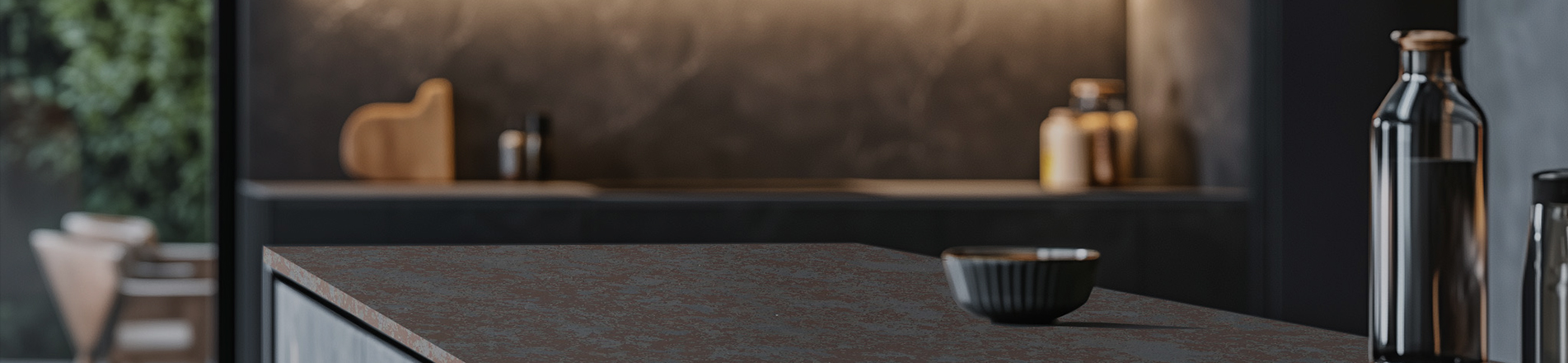
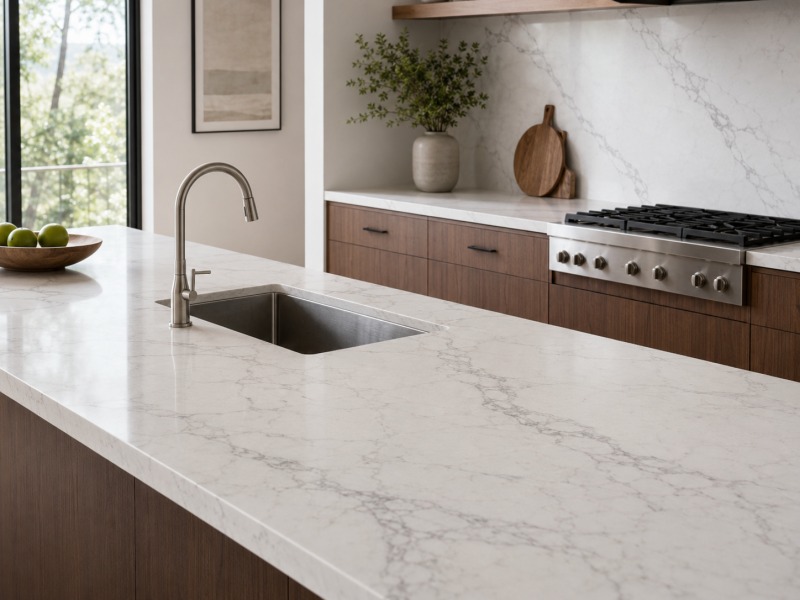
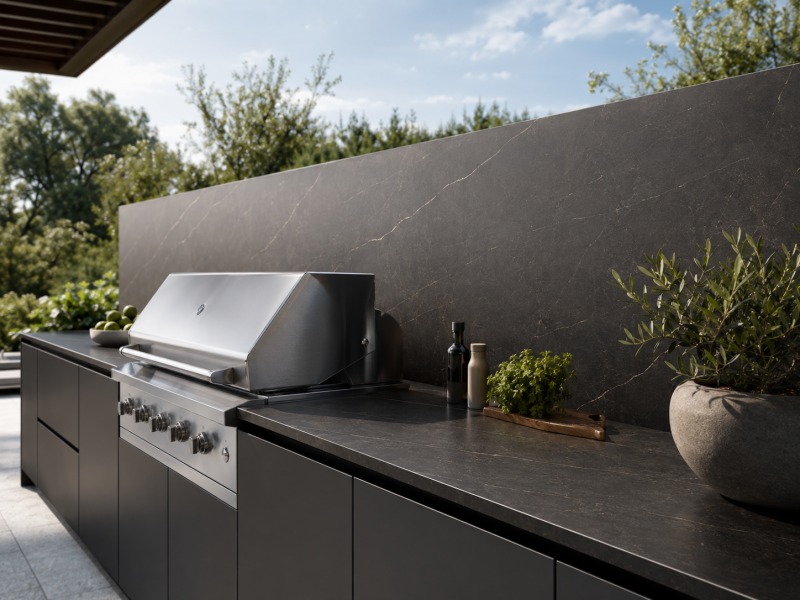
An objective comparison of application advantages,material performance, seamless design and application, fabrication, appearance, price and export transportation.
When choosing a countertop, many buyers first compare hardness, heat resistance and price. These points matter, but they do not tell the whole story. Seams, sink details, curves, repair costs, fabrication risk and transportation can have a greater effect on the finished project.
For many indoor residential and commercial projects, solid surface offers the best overall balance. It may not be the hardest or most heat-resistant material, but it provides something quartz and sintered stone cannot easily match: a smooth, nearly seamless surface that can be shaped, integrated and renewed over time.
Choose Solid Surface
when seamless joints, integrated sinks, coved backsplashes, curved shapes, easy cleaning and future repair are important.
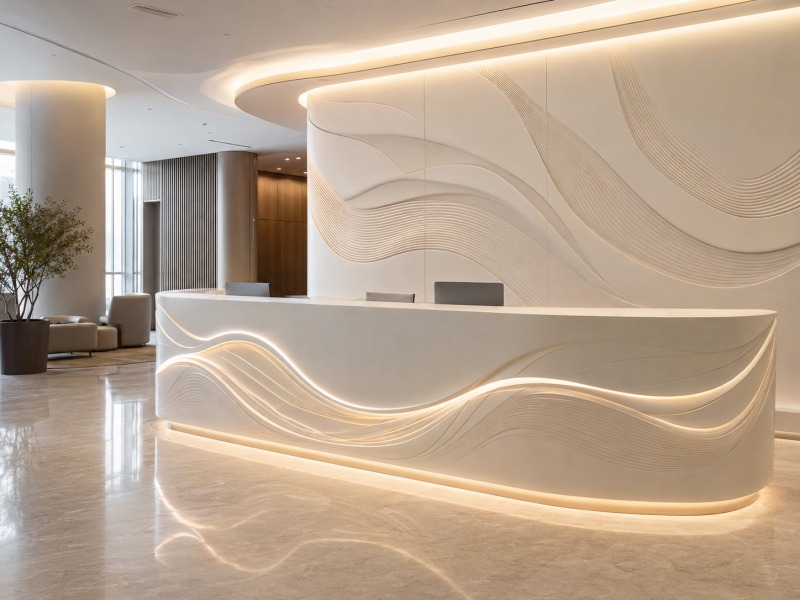
For offices and commercial interiors, choose acrylic solid surface when the design requires engraved images, logos, lettering or decorative patterns; translucent graphics; thermoforming; or coordinated interior wall cladding.
Choose quartz when a stone-like appearance and higher scratch resistance are more important than seamless detailing.
Choose sintered stone when very high heat resistance, UV stability, outdoor use or a thin large-format look is the main priority.
For kitchens, bathrooms, hospitals, hotels, laboratories, reception desks and custom commercial interiors, solid surface is often the most flexible and practical material across the complete project lifecycle.
Solid surface first: the practical difference
Solid surface is an acrylic or polyester-based material. Because the color and structure continue through the material, sheets can be joined with color-matched adhesive and sanded into one continuous-looking surface. The same property also allows scratches, stains, burns and damaged sections to be repaired more easily than on most hard-surface products.
Quartz and sintered stone are excellent materials, but they are normally installed as separate slabs or cut pieces. Their seams, sink joints and corner connections remain part of the finished design. Solid surface gives designers and fabricators more freedom to remove these visual and cleaning interruptions.
1. Product performance
Solid surface: comfortable, nonporous and renewable
Quartz: harder, but less adaptable
Sintered stone: the strongest choice for heat and UV
2. Application advantages
Why solid surface creates a cleaner and flexible finished product
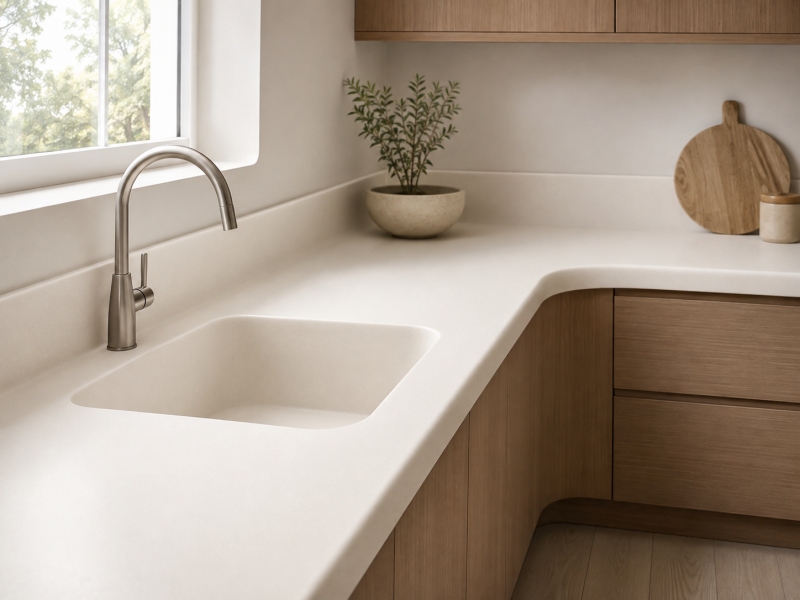
·Nearly invisible color-matched joints on long counters and L-shaped layouts.
·A coved backsplash with a rounded inside corner and no dirty silicone line.
·A rounded front edge or curved end without a visible lamination joint.
·A solid-surface basin or sink bonded to the top for one continuous, easy-to-clean transition.
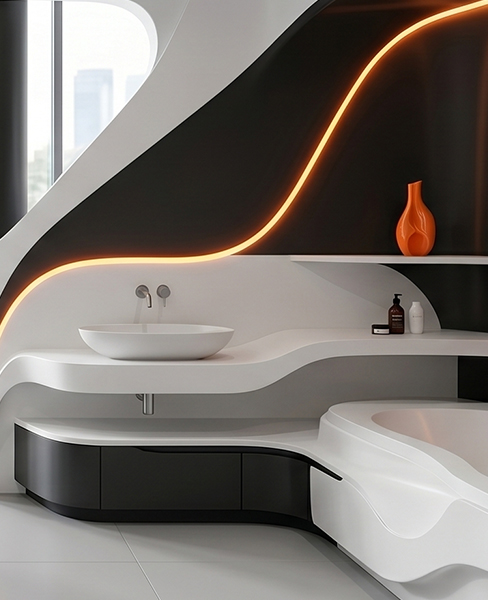
·Thermoformed shapes for reception counters, wall panels, furniture and custom commercial installations.
Where quartz and sintered stone fit
Quartz is a good option for countertops when buyers want a natural-stone look and do not need curved or seamless details. Sintered stone is especially useful for outdoor applications, thin profiles and large-format cladding. Both can create impressive waterfall ends and backsplashes.
3. Fabrication and installation
Solid surface: the most flexible fabrication process
Solid surface can be cut, routed, joined and sanded using good-quality woodworking-style equipment and the correct solid-surface procedures. Fabricators can complete many details in the workshop or adjust them on site. However good and professional workmanship is still essential.
Quartz: established stone-processing requirements
Quartz needs professional stone equipment, diamond tooling, wet cutting, polishing systems and safe lifting.
Sintered stone: experience is critical
Sintered stone usually demands the highest level of operator experience. The slab must be fully supported, the blade and cutting sequence must match the product, and corners or cutouts must not carry point loads.
4.Price and lifetime value
Pure acrylic solid surface carries the highest material cost, followed by quartz stone, and then sintered stone.Solid surface can offer better lifetime value because it can often be refinished, repaired or modified instead of fully replaced.Sintered stone cutting, edge finishing, handling and breakage allowance add cost.Quartz stone is the best cost for countertops.
5. Export Packing and Transportation
Solid Surface
Solid surface sheets are usually packed horizontally on reinforced pallets. A 20GP container can load more than 400 sheets of 3660 × 760 × 12 mm, equal to over 1,113 m² of material.
This loading method uses container space efficiently. More saleable material can be shipped in one container, resulting in a higher container value and a lower freight cost per sheet or square metre. Solid surface is also easier to handle and repair if minor damage occurs during transportation.
Quartz
Quartz slabs are normally packed vertically on A-frames. A 3200 × 1600 × 20 mm slab is heavy, and a 20GP container usually carries about 105 slabs, equal to approximately 538 m². Loading capacity is mainly limited by weight.
Sintered Stone
Sintered stone is usually packed on A-frames or reinforced wooden frames. A 20GP container can typically carry around 140–168 slabs of 3200 × 1600 × 12 mm, equal to approximately 717–860 m².
Although sintered stone is lighter than 20 mm quartz, large thin slabs are more fragile during loading, unloading and transportation. Strong edge protection and professional handling are essential.
Actual loading quantities depend on slab weight, packaging design, container payload limits and destination regulations.


 English
 Français
 Русский
 Español
 Português
 عربي
عربي